

A complete guide to what to display, how to arrange, and how to make your kitchen feel intentionally designed — not accidentally cluttered.
Introduction
There is a certain kind of kitchen that stops you in your tracks — the kind where the cabinets feel like a curated display, where every item placed behind glass feels deliberate and beautiful. If you have ever wondered how to style glass kitchen cabinets and make them look that effortlessly composed, you are not alone. It is one of the most-searched kitchen design questions for good reason: glass kitchen cabinets are both a blessing and a challenge. They invite the eye, but they also reveal everything.
Unlike solid wood doors, glass kitchen cabinet doors demand a certain level of intentionality. There is no hiding mismatched mugs or half-used spice jars behind them. But when styled thoughtfully, a kitchen with glass cabinets can look like something out of an architectural digest spread — warm, layered, and completely personal. Whether you are working with upper glass kitchen cabinets that flank a window, a full wall of glass front kitchen cabinets, or just a couple of accent glass door kitchen cabinets beside your range, the principles of styling them well are the same.
This guide covers everything: what to display and what to hide, how to approach decorating glass kitchen cabinets by kitchen style, which glass kitchen cabinet decor ideas translate across spaces, and the most common mistakes people make that turn a beautiful concept into visual noise. By the time you finish reading, you will know exactly how to approach your own glass cabinet kitchen — and you might find yourself rearranging your shelves before dinnertime.
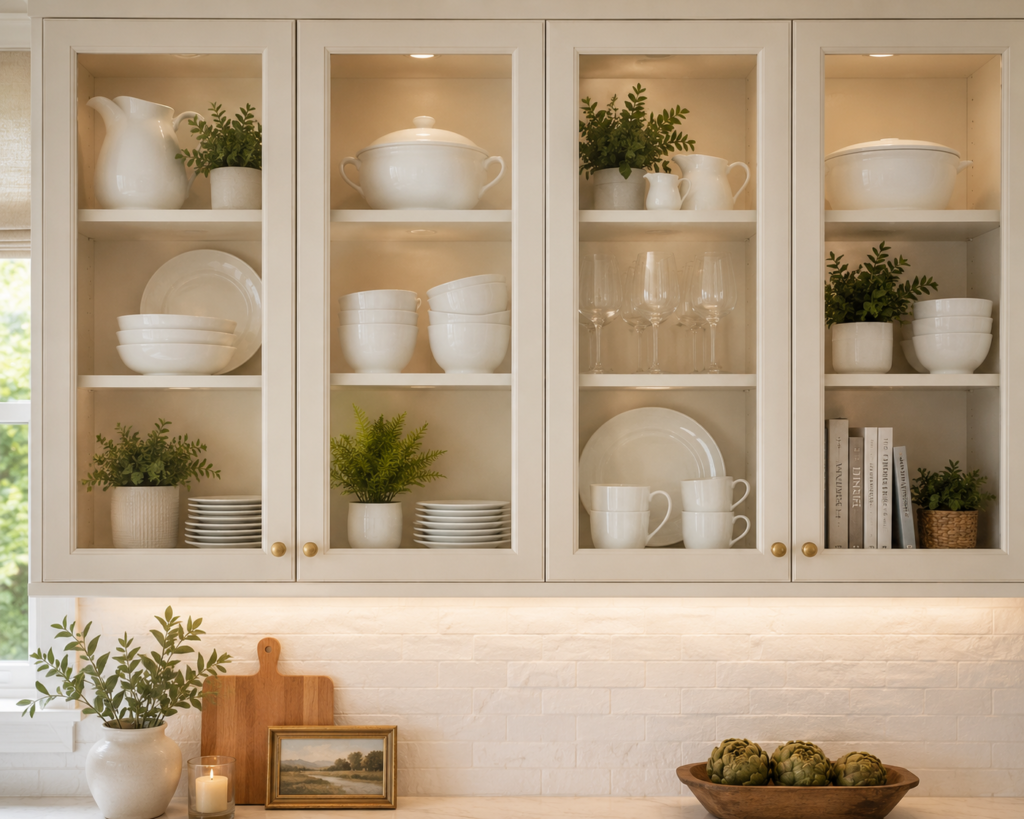
Glass front kitchen cabinets styled with curated white dishware and subtle greenery — a classic combination that never ages.
Why Glass Cabinets Change the Entire Feel of a Kitchen
Before diving into the “how,” it helps to understand what glass cabinets in a kitchen actually do to a space. On a purely functional level, they break up the visual mass of a solid-cabinet run. A wall of flat-front or even shaker doors, no matter how beautiful the finish, reads as a continuous surface. Insert a few glass door kitchen cabinets into that run and the eye suddenly has places to rest — and places to explore.
There is also a depth element. Glass for kitchen cabinets creates a sense of layering: the room, the cabinet frame, and the objects inside all occupy different visual planes simultaneously. This is why kitchens with even a single pair of upper kitchen cabinets with glass doors tend to feel larger and more finished than their fully solid counterparts.
Designers often note that glass front kitchen cabinets perform a similar function to open shelving — they create visual breathing room — but with the practical advantage of keeping items dust-free and protected. For anyone who loves the aesthetic of open shelves but hates the commitment to perpetual tidiness, cabinets with glass doors are genuinely the best of both worlds.
“A glass cabinet does not just show your things — it asks them to justify their presence. That kind of editing almost always improves a kitchen’s design.”
What to Put in Glass Kitchen Cabinets
This is the question that trips most people up: not everything belongs in a glass door kitchen cabinet. The items that read best behind glass kitchen cabinet doors share a few consistent characteristics — they have visual cohesion, they are relatively uniform in color or scale, and they are items you genuinely use and care about.
Dishware and Serveware
Stacked plates, bowls in graduating sizes, and coordinated mugs are the most natural fit for what to display in glass kitchen cabinets. White dishware is the perennial favorite because it reads as clean and intentional behind any cabinet color. But a full set of deep navy plates, warm terracotta bowls, or hand-thrown ceramic pieces can look extraordinary in glass front kitchen cabinet ideas when displayed with a consistent color story.
The key is consistency. A mismatched collection of dishes does not mean you cannot display them — it means you need to group by color or form. Pull the blue pieces together. Cluster the neutral ceramics. Create sub-groupings that each have their own logic, and the overall display will feel curated rather than chaotic.
Glassware and Bar Items
Stemware — wine glasses, champagne flutes, cocktail glasses — is one of the most beautiful things you can put in a glass cabinet for kitchen display. The transparency reads as elegance, they naturally catch the light, and a row of matching glasses creates a rhythmic, almost architectural quality. Matching matters here: a hodgepodge of mismatched glasses in a glass kitchen cabinet tends to look more like a thrift store find than a thoughtful display.
Books, Botanicals, and Objects
Not every glass cabinet kitchen needs to be purely functional. Cookbooks with beautiful spines, a small potted plant, a piece of pottery that is more sculpture than vessel, a vintage jar filled with dried pasta — these are all fair game for kitchen glass cabinet display ideas that want to feel personal and lived-in. The rule: one or two decorative objects among functional items reads as intentional; a cabinet full of objects with no practical dishware starts to feel like it belongs in a living room.
What to Keep Hidden
For every item that earns a place in a glass door kitchen cabinet, there are several that do not. Plastic containers and mismatched lids, seldom-used appliances, half-empty bottles, and cleaning supplies should live behind solid doors. Decorating kitchen cabinets well is as much about what you exclude as what you include.
Display Checklist
| ✓ Display These | ✗ Hide These |
| Matching dishware sets | Mismatched plastic containers |
| Coordinated glassware | Half-empty cleaning products |
| Ceramics with consistent glaze tones | Paper bags and rubber bands |
| Cookbooks with beautiful spines | Seldom-used dusty appliances |
| Small potted herbs or botanicals | Unmatched mugs and lids |
| Uniform jars or canisters | Random tupperware collection |
How to Style Upper Glass Kitchen Cabinets
The upper zone of your kitchen works differently from the lower zone. Upper kitchen cabinets with glass doors are at or near eye level, meaning they are the most prominent visual element in the room after the countertop. This prominence is why how to style upper glass kitchen cabinets deserves its own careful attention.
The Vertical Arrangement Principle
When styling glass upper cabinets, think about each shelf as a distinct composition rather than treating the cabinet as a single unit. The bottom shelf is most visible and should contain your most used and visually appealing items. The middle shelf can hold items that create visual interest at a slight distance. The top shelf of tall upper kitchen cabinets with glass doors is hardest to reach — this is where taller items (pitchers, vases, cake stands as pedestals) and seasonal pieces earn their place.
Handling Small Upper Cabinets with Glass Doors
require even more restraint than full-height versions. With a limited interior footprint, every item counts twice. A single pair of small glass front upper cabinets flanking a range hood is one of the most classic configurations in kitchen design — and it works best when treated as a tight vignette rather than a storage solution. Choose three to five items that feel like they belong together.
Upper Kitchen Cabinets with Glass Doors on Both Sides
If you have upper kitchen cabinets with glass doors on both sides, symmetry becomes your friend. When both sides of a cabinet are visible — whether because it is an island-mounted cabinet or a peninsula unit — the styling needs to work from multiple vantage points. The solution is straightforward: keep it sparse, keep it cohesive, and use taller items in the center.
PRO TIP
For upper cabinet glass door decor, try painting the interior back wall of the cabinet a contrasting color — a deep navy, terracotta, or matte black — before styling it. Even white dishware becomes sculptural against a dark backdrop, and the effect requires almost no additional effort or expense.
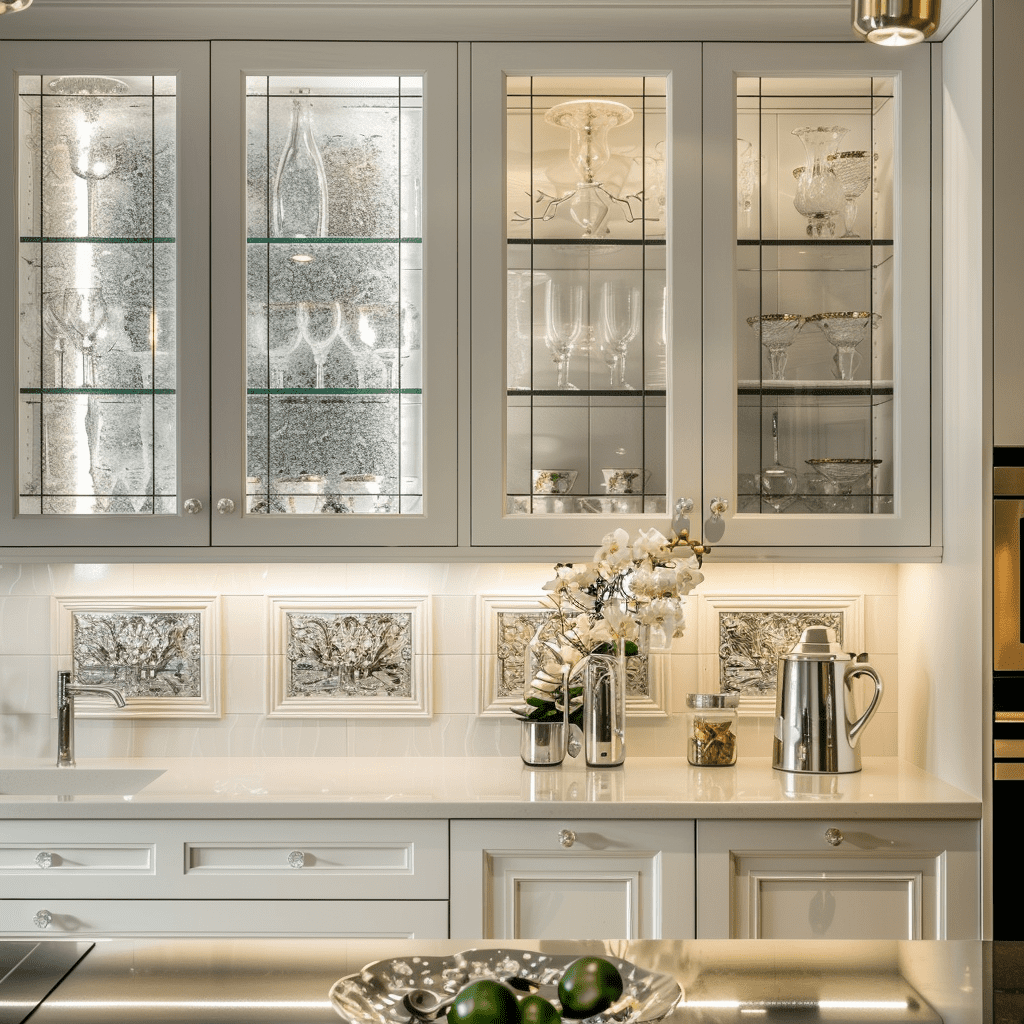
White upper kitchen cabinets with glass doors: a disciplined arrangement of plates and glassware makes the kitchen feel polished and intentional.
Choosing the Right Glass Door Type for Your Kitchen
Not all glass for kitchen cabinet doors is the same. The type of glass you choose fundamentally changes the relationship between the viewer and the cabinet interior — how much is revealed, how much is softened, and what kind of atmosphere the cabinet contributes to the overall room.
Clear Glass Kitchen Cabinets
Clear glass kitchen cabinets offer full visibility into the cabinet interior, making them the highest-stakes option. Everything is on display, all the time. This is ideal for kitchens where the owner has already committed to curated, consistent dishware. Clear cabinets work particularly well in modern, minimalist kitchens where the palette is limited and the visual grammar is spare.
Frosted Glass Upper Cabinets
Frosted glass upper cabinets and upper kitchen cabinets with frosted glass doors are the forgiving middle ground. The translucency obscures specific details while still suggesting the presence of items inside. This is an excellent option for kitchens where the owner wants the visual lightness of glass without the commitment to immaculate organization. White kitchen cabinets with frosted glass doors are particularly popular in transitional-style kitchens for this reason.
Seeded, Reeded, and Decorative Glass
Decorative glass kitchen cabinets and decorative glass cabinet doors — including seeded glass, reeded glass, and leaded glass — occupy their own aesthetic territory. These are statement-making choices. The glass texture or pattern becomes a design element in its own right. Antique glass kitchen cabinets using wavy or seeded glass bring a warmth and handmade quality to the space that no clear-pane door can replicate.
Shaker Kitchen Cabinets with Glass Doors
Shaker kitchen cabinets with glass doors are among the most versatile configurations available. The clean-lined shaker profile is compatible with traditional, farmhouse, transitional, and even contemporary styles — and swapping the solid center panel for glass adds depth without disrupting the door’s fundamental geometry. When combined with white glass kitchen cabinets in a painted shaker profile, the result is a timeless cabinet that suits almost any kitchen renovation.
Color, Lighting, and the Interior Backdrop
Styling the objects inside a glass kitchen cabinet is only half the work. The backdrop — the painted or wallpapered interior back wall — and the lighting inside the cabinet have enormous influence over how the display reads from outside the door.
Painting the Cabinet Interior
The single most impactful (and low-cost) change you can make to a glass cabinet for kitchen display is painting the interior back wall. Most cabinets come with the same paint or finish as the exterior — which means a white cabinet has a white interior. Against a white back wall, white dishes almost disappear. Against a deep forest green, navy, or charcoal, those same white dishes become luminous and defined.
For white glass kitchen cabinets specifically, interior colors that tend to perform well include: deep teal, slate gray, warm clay, and matte black. The contrast between the white frame and the dark interior creates a jewelry-box effect that makes even modest dishware look deliberately chosen.
Lighting the Display
Interior lighting for glass front kitchen cabinets is one of those upgrades that designers swear by and homeowners consistently underutilize. The options range from simple adhesive puck lights to hardwired LED strips recessed into the top of the cabinet interior. Either approach transforms the cabinet from a daytime feature to an all-hours design statement.
Warm white light (2700–3000K) is almost always preferable for kitchen glass cabinet decor. Cooler daylight bulbs (5000K+) create a clinical quality that conflicts with the warmth that most kitchen aesthetics are trying to achieve.
Modern Style Glass Kitchen Cabinets: Design Principles
Modern style glass kitchen cabinets follow a different logic than traditional or farmhouse-influenced styling. Where traditional kitchens embrace a more eclectic and layered approach, modern upper kitchen cabinets with glass doors in contemporary spaces tend to operate on principles of restraint, repetition, and material clarity.
The Monochromatic Display
In a modern style glass kitchen, one of the most powerful approaches is the monochromatic cabinet display — a single color family carried across all items within the cabinet. All-white dishware, all-black serveware, or a set of deep grey stoneware displayed against a matching dark interior creates a graphic, almost abstract quality that suits modern kitchen architecture.
Negative Space as a Design Element
Where traditional kitchen glass cabinet decor tends toward fullness and layering, modern glass cabinet styling intentionally leaves space. A single stack of plates on a wide shelf, a cluster of three glasses, one architectural object and nothing else — this kind of restraint can feel uncomfortable at first, but it is exactly how kitchens with glass cabinet doors in high-design spaces tend to be styled.
Wood Glass Kitchen Cabinets
Wood glass kitchen cabinets — where the cabinet frames are natural wood or wood-toned, whether in walnut, white oak, or ash — present a particular styling opportunity. The warmth of the wood grain paired with clear glass creates an inherently organic quality. Items that work beautifully here include natural ceramic pieces, wooden serving boards stood upright, and botanicals.
DESIGN NOTE
In stacked kitchen cabinets with glass — where floor-to-ceiling cabinetry has glass on the upper portion and solid doors below — consider treating the glass upper section as pure display and the lower solid section as pure storage. This division of labor creates visual clarity and means your glass kitchen cabinet door displays are always intentional rather than functional.

Modern glass front upper cabinets with a restrained display — fewer, better items make each piece feel deliberate and curated.
Common Mistakes When Decorating Glass Kitchen Cabinets
Even experienced home decorators make predictable missteps when they first approach decorating glass kitchen cabinets. Knowing what to avoid is just as instructive as knowing what to do.
Overcrowding Every Shelf
The single most common error in kitchen cabinet decoration is treating a glass-door cabinet exactly like a solid-door cabinet — filling every inch with whatever needs to be stored. Glass cabinets in the kitchen need to breathe. As a general rule, aim to fill no more than two-thirds of the available shelf space. The remaining third, left intentionally empty, creates the visual spaciousness that makes the display feel styled rather than packed.
Ignoring Color Cohesion
A glass kitchen cabinet displaying items from across the entire color spectrum reads as storage, not design. Before placing anything inside a glass door kitchen cabinet, pull everything out and group it by color. You may find that you have enough of one or two color families to fill the display beautifully — and that the multicolored outliers belong behind a solid door instead.
Neglecting the Back Wall
The interior back wall of a kitchen cabinet with glass doors is one of the easiest upgrades to overlook. Leaving it the same color as the exterior, particularly in white kitchens, is a missed opportunity. The back wall is the visual canvas against which your display objects are read — invest a couple of hours and a small can of paint, and the improvement is dramatic.
Mixing Too Many Scales
A shelf that holds items of wildly varying scale creates visual restlessness. When choosing what to display in upper glass kitchen cabinets, try to group items of similar or complementary scale together. Tall items together, small items together, medium items as bridging elements. This creates the kind of rhythmic, orderly quality that reads as intentional kitchen cabinet decor from across the room.
Forgetting About Seasonal Editing
The best-styled glass cabinets for a kitchen evolve. What looks beautiful in winter — dark ceramics, copper accents, evergreen sprigs — might feel heavy by spring. Treating your glass kitchen cabinet display ideas as a living arrangement rather than a set-once project allows the space to stay fresh and intentional across the year.
Glass Cabinets Across Different Kitchen Styles
The approach to how to decorate glass kitchen cabinets shifts meaningfully depending on the overall kitchen style. Here is a brief guide to styling kitchen cabinets with glass doors across the most common kitchen aesthetics:
Traditional and Farmhouse Kitchens
In a kitchen with glass upper cabinets done in a traditional or farmhouse style, embrace layering, heirloom pieces, and a slightly relaxed approach to matching. Blue-and-white transferware, ironstone platters, wooden boards stood upright, vintage crockery — these all look beautiful in glass front kitchen cabinets in a farmhouse context. The display can be fuller here; a certain abundant quality is part of the aesthetic.
Transitional Kitchens
Transitional kitchens are the most common residential kitchen style, and upper kitchen cabinets with glass doors are a staple feature. Here, the styling sweet spot is a mix of uniformity (matching dishware in a consistent color) with one or two personality pieces (a small plant, a ceramic object) that prevent the display from feeling too corporate. White kitchen cabinets with glass doors are the dominant configuration in this category.
Contemporary and Minimalist Kitchens
As discussed in the modern style section, glass kitchen cabinet design in truly contemporary spaces leans into restraint. A corner glass kitchen cabinet in a sleek flat-front kitchen might hold nothing but a set of matching matte black bowls and a single architectural object. The styling confidence here comes from knowing that less, done precisely, reads as sophistication.
Cottage and Eclectic Kitchens
In a cottage or eclectic kitchen, the rules relax considerably. Kitchen glass cabinet decor in these contexts can mix periods, colors, and functions more freely — as long as there is a unifying thread (perhaps texture, or a dominant color that recurs across the items). Floral china mixed with cottage pottery, a row of mismatched-but-beloved mugs — these are entirely at home in a decorative kitchen cabinet in an eclectic space.
Styling a Corner Glass Kitchen Cabinet
A corner glass kitchen cabinet presents a unique challenge because of its geometry. For this configuration, consider treating each visible shelf face as its own small vignette. Taller items at the outer edges and a central focal piece work well. The outward-facing portion of every shelf should hold something worth looking at.
Frequently Asked Questions
What is the best way to style glass kitchen cabinets without making them look cluttered?
The most effective approach to styling glass kitchen cabinets without clutter is the rule of two-thirds: fill only two-thirds of available shelf space, restrict your display palette to two or three colors, and group items by form and scale. Ruthless editing before anything goes in is the key — if an item makes you hesitate, it belongs behind a solid door.
What should I put in kitchen cabinets with glass doors?
The best candidates for what to put in kitchen cabinets with glass doors are items that are visually cohesive and genuinely attractive: matching dishware, coordinated glassware, ceramics with consistent glaze tones, cookbooks with beautiful spines, small botanicals, and uniform canisters or jars. Avoid anything mismatched, plastic-dominant, or purely functional without visual appeal.
Should I remove cabinet doors and use open shelving instead of glass?
Open shelving and glass door kitchen cabinets serve similar visual functions but glass doors have the practical advantage of protecting items from dust, grease, and kitchen steam. Unless you have dedicated time for very frequent cleaning and tidying of open shelves, glass kitchen cabinet doors are the more forgiving and functional choice for most households.
How do I decorate upper glass kitchen cabinets that are too high to use daily?
When upper glass kitchen cabinets are too high for everyday access, treat them as pure display space rather than storage. Use taller, more sculptural items — a ceramic jug, a stack of beautiful trays, seasonal botanicals, architectural objects — that look beautiful from below and do not need to be retrieved regularly. Lighting these cabinets from the inside emphasizes their display-only character.
What is the difference between frosted and clear glass for kitchen cabinet doors?
Clear glass kitchen cabinets show everything inside in full detail — requiring consistent, curated organization. Frosted glass upper cabinets diffuse the view, suggesting the presence of items without revealing specifics. Frosted glass is the more forgiving choice for busy kitchens; clear glass rewards the fully committed curator.
How do I light the inside of glass kitchen cabinets?
The easiest entry point is battery-operated LED puck lights or strip lights installed on the top interior of the cabinet — no wiring required. For a more polished result, hardwired LED strips recessed into the cabinet interior are the professional standard. In either case, choose warm white bulbs in the 2700–3000K range to complement the warm tones of most kitchen environments.
Can I mix glass door cabinets with solid door cabinets?
Absolutely — and this is in fact the most common and practical approach. A full run of glass front kitchen cabinets can be visually overwhelming and demands perfect organization throughout. Mixing a few glass door kitchen cabinets with predominantly solid-door cabinetry gives you display zones without the commitment of full transparency. Typically, glass doors work best in upper cabinets flanking windows or ranges, while solid doors handle lower storage.
What are the best color schemes for styling glass kitchen cabinet interiors?
The most reliable color approaches for glass kitchen cabinet display ideas are the all-white or neutral palette, the monochromatic deep palette (all-navy, all-earth-tone ceramics), and the natural/organic palette (warm wood tones, terracotta, sage green, cream). In all cases, limiting the active palette to two or three colors — and sticking to them — produces the most cohesive result.
Conclusion
Knowing how to style glass kitchen cabinets is ultimately about developing an editor’s eye — the ability to look at a collection of objects and ask which ones earn their visibility and which ones do not. Glass kitchen cabinet doors are essentially a stage: every item you place inside is a performer, and the ones that do not contribute to the story should be quietly moved backstage.
Whether you are working with white glass kitchen cabinets in a transitional space, modern upper kitchen cabinets with glass doors in a contemporary open-plan, or a pair of small upper kitchen cabinets with glass doors beside a farmhouse range, the principles remain consistent: curate ruthlessly, prioritize color cohesion, use negative space intentionally, and do not underestimate the power of interior paint and lighting.
Decorating glass kitchen cabinets is one of the highest-return investments of time and effort in kitchen design. You are not buying anything new. You are simply choosing, with intention, what deserves to be seen — and letting that choice speak for the whole room.