

Ever scrolled past a listing that said “no mortgage needed, move in today” and wondered if it was too good to be true? That’s usually a rent to own home, and for a growing number of Americans, it’s becoming a real bridge between renting forever and owning a place of their own. If you’ve ever felt stuck between sky-high down payments and rent that just disappears every month, this option might be worth a serious look.
Here’s why this matters right now. Home prices have climbed nearly 55% nationwide between early 2020 and late 2025, and the median existing home now costs somewhere around $412,000 to $427,000. Meanwhile, the share of first-time buyers in the market dropped to a historic low of just 21% of all home purchases last year. Saving a traditional down payment in that environment feels less like a goal and more like chasing a moving target.
That’s exactly the gap rent to own arrangements try to fill. Instead of waiting years to save enough cash while rent payments vanish into a landlord’s pocket, you move into a home now, lock in tomorrow’s purchase price today, and use part of your monthly payment to work toward eventually buying the place. It’s not magic, and it’s definitely not for everyone, but for the right buyer in the right situation, it can be a genuinely smart move.
In this guide, we’ll walk through exactly how these deals work, what they cost, where the real risks hide, and how to find legitimate options near you — including a closer look at how things play out in tighter markets like New York City.
What Is Rent to Own, Exactly?
A rent to own home is a property you lease with an agreement that also gives you the right — and sometimes the legal obligation — to purchase that same home once your lease term ends. Think of it as a hybrid between a standard rental and a home purchase. You’re not just paying for a roof over your head; you’re paying your way toward a future closing date.
Most agreements fall into one of two categories:
- Lease-option agreements — You have the option to buy the home when the lease ends, but you’re not required to. If you walk away, you simply forfeit any money you’ve put toward the purchase.
- Lease-purchase agreements — You’re contractually obligated to buy the home at the end of the lease term. Backing out can expose you to legal and financial consequences.
Understanding which type of contract you’re signing is one of the most important things you’ll do in this entire process, so don’t skip reading the fine print.
How Does Rent to Own Work in Practice?
If you’re wondering how does rent to own work day to day, here’s the basic structure most agreements follow:
- You find a home and negotiate a rent to own agreement with the seller, often through a real estate agent or a specialized program.
- You pay an upfront, non-refundable option fee — typically 1% to 7% of the home’s value, depending on the market and the seller. On a $350,000 home, that could mean anywhere from $3,500 to $24,500 due at signing.
- You sign a lease, usually lasting one to three years, and move in.
- Each month, you pay rent — and a portion of that rent (called a rent credit) is set aside, often in an escrow account, to go toward your future down payment.
- When the lease ends, you apply for a mortgage to cover the remaining purchase price, which was typically locked in when you signed the original agreement.
This setup means you’re essentially renting with an option to buy, giving yourself time to repair credit, save additional cash, and prove a stable payment history before a lender ever reviews your mortgage application.

Couple reviewing a rent to own home agreement at the kitchen table
Why People Are Turning to Rent to Own Right Now
It’s not hard to see why interest in rent to own places near me searches has climbed. According to the U.S. Census Bureau, the national homeownership rate sits at roughly 65.7%, but for adults under 35, that number drops to around 37.5%. A huge share of renters want to own — research from The Zebra found that roughly 80% of millennials would like to eventually own a home — but affordability keeps getting in the way. The most common obstacle renters report isn’t bad credit or lack of desire; it’s simply the cost of housing in the area where they want to live.
According to the Association of Professional Rental Organizations’ 2026 Industry Health Survey, an estimated 6.7 million Americans used a rent-to-own arrangement in 2025 alone, representing roughly one out of every twenty U.S. households. That’s a meaningful chunk of the population using this path, not a fringe strategy.
There are a few clear reasons this model appeals to so many people:
- Locked-in purchase price. In a market where prices keep climbing, agreeing on today’s price for a home you’ll buy in two or three years can work heavily in your favor.
- Time to fix your credit. If your score isn’t quite where a lender wants it, a lease period gives you breathing room to improve it without losing the home you want.
- Built-in forced savings. Because part of your rent goes toward the purchase, you’re saving automatically each month instead of hoping there’s something left over.
- A real test drive. You get to live in the home, the neighborhood, and the school district before fully committing — something a traditional purchase never allows.
That said, this approach isn’t risk-free, and it’s worth being honest about the downsides before you sign anything.
The Real Risks of Rent to Own Agreements
This is the part most flashy listings gloss over, and it deserves your full attention. The Federal Trade Commission has warned that some of these deals can be structured in ways that disadvantage buyers, so doing your homework before signing is non-negotiable.
Here’s what tends to trip people up:
You’re Paying a Premium
Rent-to-own monthly payments typically run $200 to $500 higher than comparable market rent in the same area. That extra money funds your rent credit, but it’s worth running the numbers yourself. If you’re paying a $300 monthly premium and only 25% of it counts as a credit, you’re spending $1,200 a year to bank just $300 toward your future purchase — money that could grow faster in a basic savings account with none of the forfeiture risk.
The Option Fee Is Almost Always Non-Refundable
That 1% to 7% fee you pay upfront secures your right to buy — but if your plans change, you can’t qualify for a mortgage, or you simply decide not to move forward, that money is gone. So is any rent credit you’ve built up. You walk away having effectively paid above-market rent for nothing.
Home Values Don’t Always Go Up
It’s easy to assume property values only climb, but that’s not guaranteed. Some markets have actually softened recently — rents in Austin, for example, dropped roughly 22% from their 2023 peak, and San Francisco saw a similar pullback. If you lock in a purchase price and the home’s value drops by the time your lease ends, you could end up paying significantly more than the home is actually worth.
Maintenance May Fall on You
In many rent-to-own contracts, the tenant — not the landlord — is responsible for repairs and upkeep during the lease. That’s a meaningful shift from a typical rental, and it’s easy to overlook until something breaks.
Consumer Complaints Around Pricing
Industry surveys have found that roughly 27% of rent-to-own customers cite high prices as their top complaint. That premium can be worth it if you genuinely follow through on the purchase, but it stings if circumstances change.
A real estate attorney reviewing your contract before you sign is one of the smartest investments you can make in this process. It’s a small upfront cost compared to the thousands you could lose in a poorly structured deal.
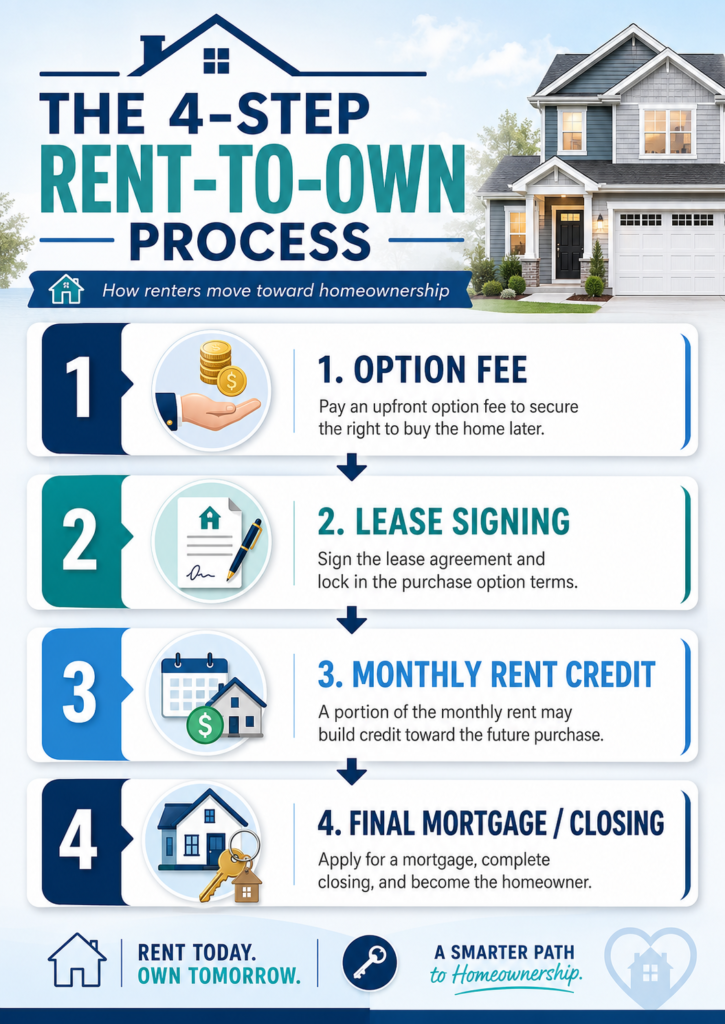
The four-step rent to own process — option fee, lease signing, monthly rent credit, and final mortgage/closing
How to Find Legitimate Rent to Own Homes Near You
If you’re searching for rent to own places near me or lease to own homes near me, you’ll find a mix of dedicated platforms, real estate listing sites, and local investors offering these arrangements. Here’s how to approach the search wisely.
Use the Right Search Tools
Sites like Zillow, Trulia, and Realtor.com let you filter listings using terms like “lease option” or “rent to own.” Searching rent.to own style phrasing on these platforms often surfaces listings that wouldn’t show up under a standard rental or for-sale search. It also helps to check local classifieds and community boards, since private sellers sometimes advertise these deals locally rather than through major listing sites.
Work With an Experienced Agent
A real estate agent familiar with homes rent to own transactions in your target area can help you avoid sketchy deals and negotiate better terms — including a lower option fee or a higher rent-credit percentage.
Consider Institutional Programs
Companies that specialize in rent-to-own programs tend to offer more standardized, consumer-protective contracts than individual sellers. They’re not perfect, and they still profit from the arrangement, but their terms are usually more transparent than a one-off deal with a private landlord.
Check Pre-Foreclosure and Motivated Seller Listings
Sellers facing financial pressure are sometimes more open to flexible lease-to-own arrangements because it gives them steady income while they work toward a sale. These deals require extra diligence, but they can also come with more room to negotiate.
Get Pre-Approved Where Possible
Even though you’re not buying immediately, getting a sense of your mortgage eligibility — or working toward a Certified Approval — shows sellers you’re a serious buyer and helps you understand whether you’ll actually qualify for financing when your lease ends.
Rent to Own Homes in NYC: What Makes the Market Different
New York City is one of the most searched markets for rent to own homes nyc, and for good reason — it’s also one of the toughest places in the country to save for a traditional down payment. The average one-bedroom rent in NYC has been reported around $4,300, the highest in the nation, which makes the idea of locking in tomorrow’s purchase price today especially appealing.
A few things make NYC’s rent-to-own landscape unique:
- Borough variation matters. Programs and option fees can look very different in Queens or Brooklyn compared to Upstate New York, where flexibility tends to be greater and fees tend to run lower due to different market dynamics.
- Co-ops are more common than condos. Rent-to-own arrangements show up more frequently in co-op buildings than in condo buildings, and co-ops often carry steeper down payment requirements once you’re ready to buy.
- There are real examples to point to. Several rent-to-own condo buildings exist in neighborhoods including Tribeca, the Lower East Side, the East Village, and Long Island City.
- State protections apply. New York has specific consumer protections around rent-to-own transactions, designed to make sure buyers aren’t entering agreements they don’t fully understand.
If you’re house-hunting in the city, working with a local agent who has handled these contracts before isn’t optional — it’s essential. NYC contracts tend to be more complex than what you’d find in many other markets, and the stakes of getting it wrong are higher given local price points.
New York City brownstone homes with a “Rent to Own” listing sign
Questions to Ask Before You Sign
Before committing to any lease-to-own agreement, walk through these questions with a clear head — and ideally with an attorney by your side:
- Is this a lease-option or a lease-purchase agreement, and do I understand the difference in obligation?
- What percentage of my monthly rent actually counts as a credit toward the purchase?
- Is the option fee refundable under any circumstances?
- Who is responsible for maintenance, repairs, property taxes, and insurance during the lease?
- Is the purchase price fixed now, or will it be determined later based on a future appraisal?
- What happens if I can’t secure a mortgage when the lease ends?
- Has the seller’s mortgage and title been verified, so I know they can legally sell the home?
Asking these questions upfront — and getting the answers in writing — is the difference between a smart bridge to homeownership and a costly mistake.
Frequently Asked Questions
What is the difference between rent to own and renting with option to buy?
They’re generally the same concept described two different ways. Rent with option to buy typically refers to a lease-option agreement, where you have the choice — but not the obligation — to purchase the home once your lease ends. “Rent to own” is often used as an umbrella term that can include both option-based and obligation-based contracts, so it’s worth clarifying which type you’re signing.
How does rent to own work if I can’t get a mortgage at the end of the lease?
In most lease-option agreements, you simply lose the right to buy along with your option fee and any accumulated rent credits, but you’re not legally forced to purchase. In a lease-purchase agreement, however, you may be contractually obligated to buy regardless of your financing situation, which can expose you to legal consequences if you can’t follow through. This is exactly why understanding your contract type matters so much before you sign.
How much is a typical option fee for rent to own homes?
Option fees generally range from 1% to 7% of the home’s purchase price, though many programs land closer to 2% to 5%. On a $350,000 home, that could mean anywhere from $3,500 to roughly $24,500 paid upfront and typically non-refundable.
Are rent to own homes near me hard to find?
They can take more digging than a standard rental or for-sale listing, but they’re out there. Searching major listing sites with terms like “lease option,” working with a local agent experienced in these deals, and checking community boards or local classifieds all improve your odds of finding legitimate options nearby.
Is this a good option for first-time buyers?
It can be, especially if your main obstacle is needing more time to save a down payment or improve your credit score. It’s worth less for buyers who are already mortgage-ready, since you’d likely save more money going straight into a conventional purchase rather than paying rent premiums and a non-refundable option fee.
What’s the difference between lease-option and lease-purchase agreements?
A lease-option gives you the right to buy without obligating you to follow through, while a lease-purchase legally requires you to complete the purchase at the end of the lease term. The lease-option route generally carries less risk for buyers since walking away only costs you the fees already paid, not a legal obligation to close.
Can I negotiate the terms of a lease-to-own contract?
Yes, and you generally should. Purchase price, the percentage of rent credited toward the down payment, the length of the lease, and who handles maintenance are all points that can often be negotiated, especially with private sellers rather than large institutional programs.
Are lease to own homes near me more expensive than regular rentals?
Typically, yes. Because a portion of your payment is being set aside as a rent credit, monthly costs usually run $200 to $500 higher than comparable market rent in the same area. That premium is the cost of building toward ownership, so it’s worth comparing carefully against simply saving on your own.
Is this option available in competitive markets like NYC?
Yes, though availability varies by borough and building type. Rent-to-own arrangements in New York are more commonly found in co-op buildings than condos, with examples in neighborhoods like Tribeca, the Lower East Side, and Long Island City, while areas outside the five boroughs often offer more flexible terms and lower fees.
Final Thoughts
Rent to own isn’t a shortcut, and it isn’t a scam either — it’s a tool, and like any financial tool, its value depends entirely on how well it fits your specific situation. For someone who needs another year or two to rebuild credit or save a larger down payment while locking in today’s price on a home they love, it can be exactly the bridge they need. For someone who’s already mortgage-ready, the premiums and fees baked into these deals usually make a traditional purchase the smarter route.
If you do decide to pursue this path, take your time, read every line of the contract, and bring in a real estate attorney before you sign anything. The difference between a rent-to-own success story and a costly setback almost always comes down to how carefully the deal was reviewed before move-in day. Whether you’re searching in a major market like New York City or browsing listings in your own neighborhood, going in informed is what turns this option from a gamble into a genuine plan.