
Discover how decoradtech is transforming modern homes with smart devices, room-by-room upgrade tips, setup guides, and expert advice for real results.
There’s a particular kind of frustration that comes from standing in your own living room, phone in hand, trying to figure out why the lights won’t turn off, the thermostat won’t hold a temperature, and three different apps are all fighting for control of the same speaker. If that sounds familiar, you’re not alone — and you’re also not doing anything wrong. You just haven’t been introduced to decoradtech yet.
Decoradtech is the practical, no-nonsense approach to blending home decor with smart technology so your house actually works the way you expect it to, without turning your living room into a tangle of blinking gadgets and forgotten passwords. It’s less about buying every shiny device on the market and more about making thoughtful, connected choices that genuinely improve how your home functions day to day.
This matters because the average household now owns more connected devices than most people can name off the top of their head — smart speakers, video doorbells, robot vacuums, smart plugs, connected thermostats — and yet a huge number of them sit half-configured, underused, or quietly disconnected from the rest of the system. The goal of this guide is to change that, walking through exactly how upgrades home decoradtech style can make your space smarter, safer, and genuinely more comfortable to live in.
By the end, you’ll know not just what to buy, but how to think about your home as a system — one where every device talks to the others instead of competing for attention.
What Is Decoradtech, Really?
At its core, decoradtech is the intersection of interior design sensibility and functional home automation. It’s not a single product or brand — it’s a philosophy. Instead of scattering random gadgets around your house because they were on sale, decoradtech asks a simple question before every purchase: does this device make my home more comfortable, more efficient, or more secure, and does it fit visually into the space it lives in?
This distinction matters more than people realize. A smart bulb that clashes with your lamp’s aesthetic or a hub with a dozen blinking lights on your bookshelf isn’t really an upgrade — it’s clutter with a Wi-Fi connection. True smart home decoradtech thinking treats design and function as equal partners, not competing priorities.
Why the Old Approach to Smart Homes Falls Short
Most people’s first smart home purchase happens on impulse — a smart plug during a sale, a video doorbell after a package theft, a voice assistant as a gift. Each device works fine on its own, but none of them were chosen with the others in mind. The result is a home full of disconnected tools rather than one cohesive system.
Research from home technology analysts has consistently shown that the biggest driver of smart device abandonment isn’t cost — it’s complexity. When a device is hard to set up, hard to maintain, or doesn’t integrate with what’s already installed, people simply stop using it within a few months. That’s the exact problem decoradtech is designed to solve.
Why Smart Home Decoradtech Is Changing the Way We Live
The shift toward smart home decoradtech isn’t just a trend — it reflects real changes in how people want their living spaces to function. A few forces are driving this:
- Energy costs are rising, and smart thermostats, sensors, and lighting systems can meaningfully cut utility bills. The U.S. Department of Energy has noted that properly programmed smart thermostats can reduce heating and cooling costs by roughly 10 percent annually for the average household.
- Remote work is now permanent for millions of people, which means home comfort and reliability matter more than ever — a flickering connection or an unreliable smart lock isn’t just annoying, it disrupts your workday.
- Security concerns have pushed more households toward connected cameras, sensors, and smart locks that can be monitored from anywhere.
- Aging in place is a growing priority, with smart lighting, voice controls, and automated routines helping older adults stay independent longer.
None of these needs are solved by buying gadgets at random. They’re solved by approaching your home upgrade decoradtech journey with intention — starting with a clear picture of what problem you’re actually trying to fix.
Home Upgrade Decoradtech: Where to Start
Before buying anything, it helps to map out your home in terms of rooms, routines, and pain points rather than products. Ask yourself what actually bothers you day to day. Is it forgetting to lock the door? Fumbling for a light switch in the dark? A thermostat that never seems to match the weather outside?
Once you have a list of real problems, home upgrade decoradtech becomes a lot simpler, because you’re shopping for solutions instead of shiny objects.
How to Set Up My Home Decoradtech in Five Steps
If you’re wondering how to set up my home decoradtech system from scratch, here’s a straightforward path that avoids the common traps:
- Choose one ecosystem as your hub. Whether that’s a voice assistant platform or a dedicated smart home hub, pick one system that most of your devices will connect to. Mixing three incompatible ecosystems is the number one reason smart homes become frustrating.
- Start with your Wi-Fi. A mesh router system is often the unsung hero of a good setup — most device failures trace back to weak or inconsistent signal strength, not the devices themselves.
- Tackle one room at a time. Don’t try to automate the entire house in a weekend. Start with the living room or bedroom, get it working reliably, then expand.
- Automate routines, not just devices. A smart bulb is nice. A routine that turns on the porch light, unlocks the door, and adjusts the thermostat the moment you arrive home is genuinely useful.
- Test before you commit. Run each new device for a week before adding the next one. This makes it far easier to spot connectivity issues early instead of troubleshooting five devices at once.
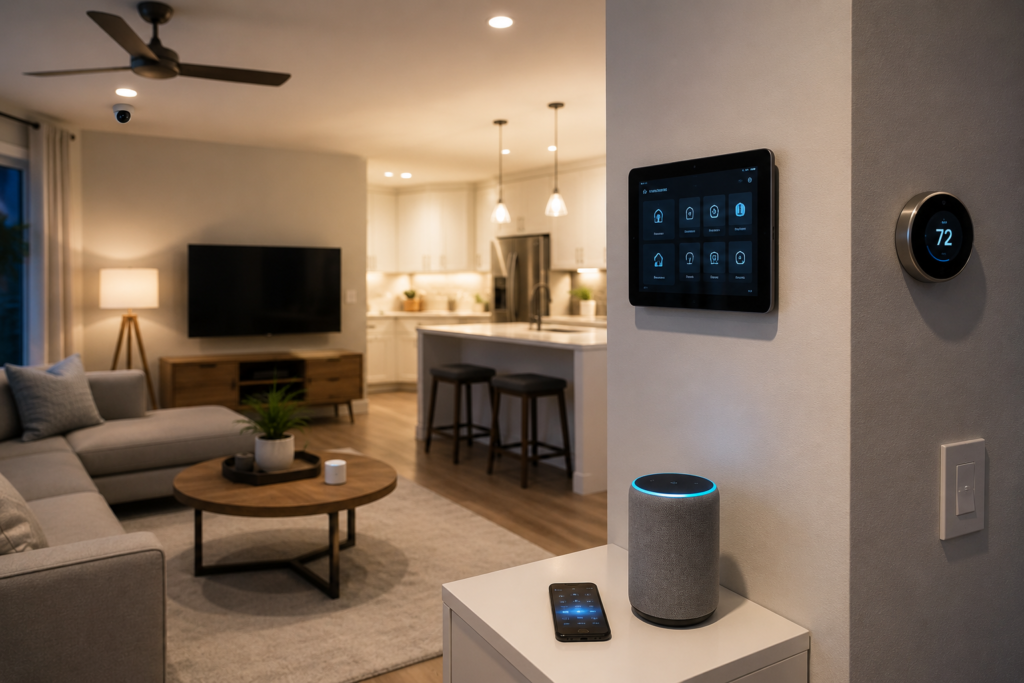
Smart home technology setup with connected devices in a modern living space
Choosing the Right Home Device Decoradtech for Your Space
Not every gadget deserves a spot in your home, and picking the right home device decoradtech additions depends heavily on your layout, your habits, and — frankly — your patience for maintenance.
Lighting
Smart lighting remains one of the highest-value upgrades because it touches both mood and function. Tunable white and color bulbs let you shift a room’s atmosphere throughout the day, while motion-triggered lighting in hallways and closets solves a problem most people didn’t even realize bothered them.
Climate Control
A smart thermostat that learns your schedule pays for itself over time through lower energy bills, and pairing it with room sensors solves the classic problem of one room being freezing while another is stifling.
Security
Video doorbells, smart locks, and window sensors form the backbone of most people’s first serious step into home smart decoradtech territory. These devices aren’t just convenient — they provide real peace of mind, especially for households that travel often or have package deliveries during work hours.
Cleaning and Maintenance
Robot vacuums and mops have matured significantly, with mapping technology that avoids obstacles and remembers room layouts. They’re not flashy, but they quietly save hours every month.
Entertainment and Ambiance
Smart speakers, connected displays, and automated shades round out the experience, letting a single voice command or scheduled routine set the tone for movie night or a quiet morning.
How to Upgrade My Home Decoradtech Room by Room
A common mistake is trying to overhaul the entire house at once. A calmer, more sustainable approach to how to upgrade my home decoradtech setup is to move room by room, prioritizing based on daily use.
Living Room
Start here because it’s where most households spend the bulk of their time. A smart speaker, connected lighting, and a streaming device with voice control create an immediate, noticeable improvement.
Kitchen
Smart plugs for small appliances, under-cabinet motion lighting, and a connected display for recipes or timers make the kitchen genuinely easier to use, not just more high-tech for its own sake.
Bedroom
Blackout smart shades, a sunrise-simulating alarm, and a thermostat schedule tuned for better sleep can measurably improve rest quality. Sleep researchers have long pointed to consistent room temperature — generally in the mid-60s Fahrenheit — as one of the simplest ways to improve sleep, and automation makes hitting that number effortless.
Entryway and Exterior
This is where security-focused home upgrading decoradtech choices matter most: video doorbells, smart locks, and motion-activated exterior lighting. These are frequently the devices people wish they’d installed sooner, especially after a missed delivery or a late-night arrival home.
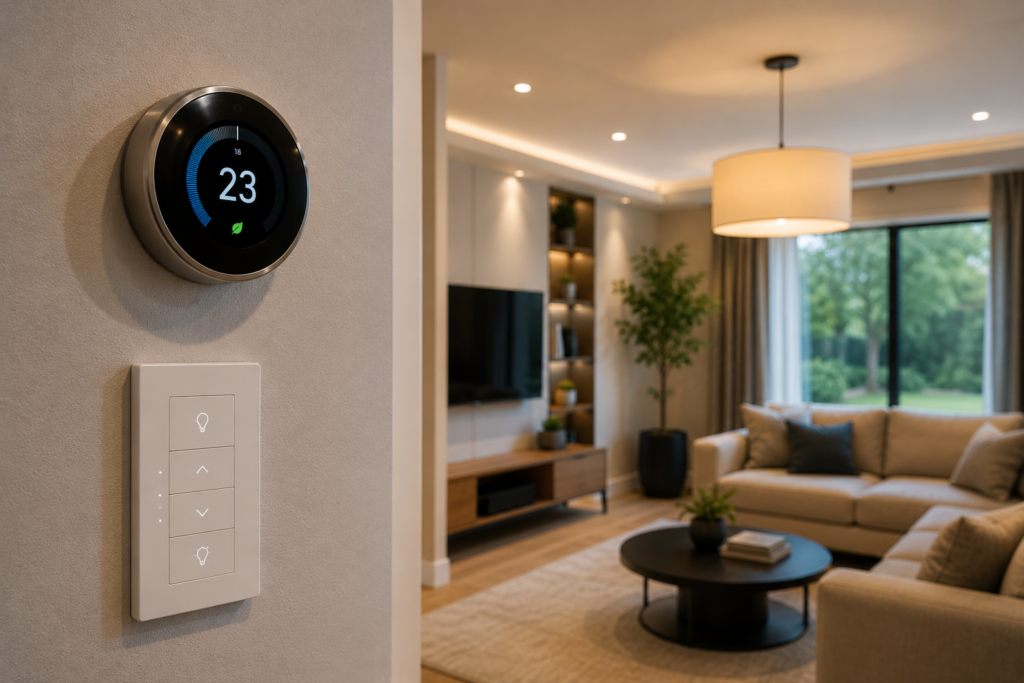
Smart thermostat and lighting controls shown as part of a home upgrade
Decoradtech Home Devices from Decoratoradvice: What Sets Them Apart
When people search for decoradtech home devices from decoratoradvice, they’re usually looking for curated recommendations rather than an overwhelming list of every product on the market. That curation matters. The difference between a good smart home and a frustrating one often comes down to whether the devices were chosen to work together from the start, or bolted on individually without a plan.
A thoughtful curation approach typically prioritizes:
- Compatibility first — checking that a device works with your existing hub or voice assistant before checking the price.
- Design integration — favoring devices that look intentional in a room rather than like an add-on.
- Long-term support — choosing brands with a track record of software updates, since an abandoned app can turn a great device into a paperweight within a year or two.
- Realistic budgeting — starting with a handful of high-impact devices instead of spreading a budget too thin across a dozen gadgets.
This is really the essence of good home device decoradtech decision-making: fewer, better choices that actually get used, rather than a drawer full of devices that were interesting for a week and then forgotten.
Home Smart Decoradtech Mistakes to Avoid
Even well-intentioned upgrades can go sideways. Here are the mistakes that come up most often when people dive into home smart decoradtech projects without a plan.
Buying Devices Before Checking Compatibility
It’s tempting to grab whatever’s on sale, but a device that doesn’t talk to your existing hub becomes dead weight fast. Always check compatibility before checking out.
Ignoring Network Capacity
Every smart device adds load to your home network. A router that was fine for two laptops and a phone may struggle once fifteen or twenty smart devices join the mix, leading to dropped connections and delayed commands.
Skipping Firmware Updates
Outdated firmware is one of the most common causes of both malfunctioning devices and security vulnerabilities. Setting devices to auto-update, where possible, saves a lot of headaches.
Overcomplicating Automations
Automations that try to do too much at once — dimming lights, changing music, adjusting the thermostat, and locking doors all from one trigger — are more likely to fail or misfire. Simpler automations tend to be far more reliable.
Forgetting About Guests and Family
A smart home that only one person in the household knows how to operate isn’t really finished. Make sure everyone who lives there understands the basics, and keep a simple backup method (a physical switch or lock) for anything critical.
Cost, ROI, and Long-Term Value of Home Upgrading Decoradtech
One of the most common questions people have before committing to home upgrading decoradtech projects is whether it’s actually worth the money. The honest answer: it depends on which devices you choose, but several categories consistently pay for themselves.
Smart thermostats are widely regarded as one of the best returns on investment in home technology, often paying back their cost within one to two years through energy savings alone. Smart lighting, particularly motion-triggered and scheduled lighting, reduces wasted electricity in rooms that are frequently left on unnecessarily. Security devices, while harder to quantify in dollars, often provide value through lower insurance premiums — many insurers now offer discounts for monitored smart security systems.
Beyond the financial side, there’s real value in convenience and time saved. A robot vacuum that runs on a schedule, a lighting system that adjusts itself, and a thermostat that learns your patterns collectively remove dozens of small daily decisions from your plate. That’s not something that shows up on a spreadsheet, but anyone who’s lived with a well-set-up smart home will tell you it’s noticeable.
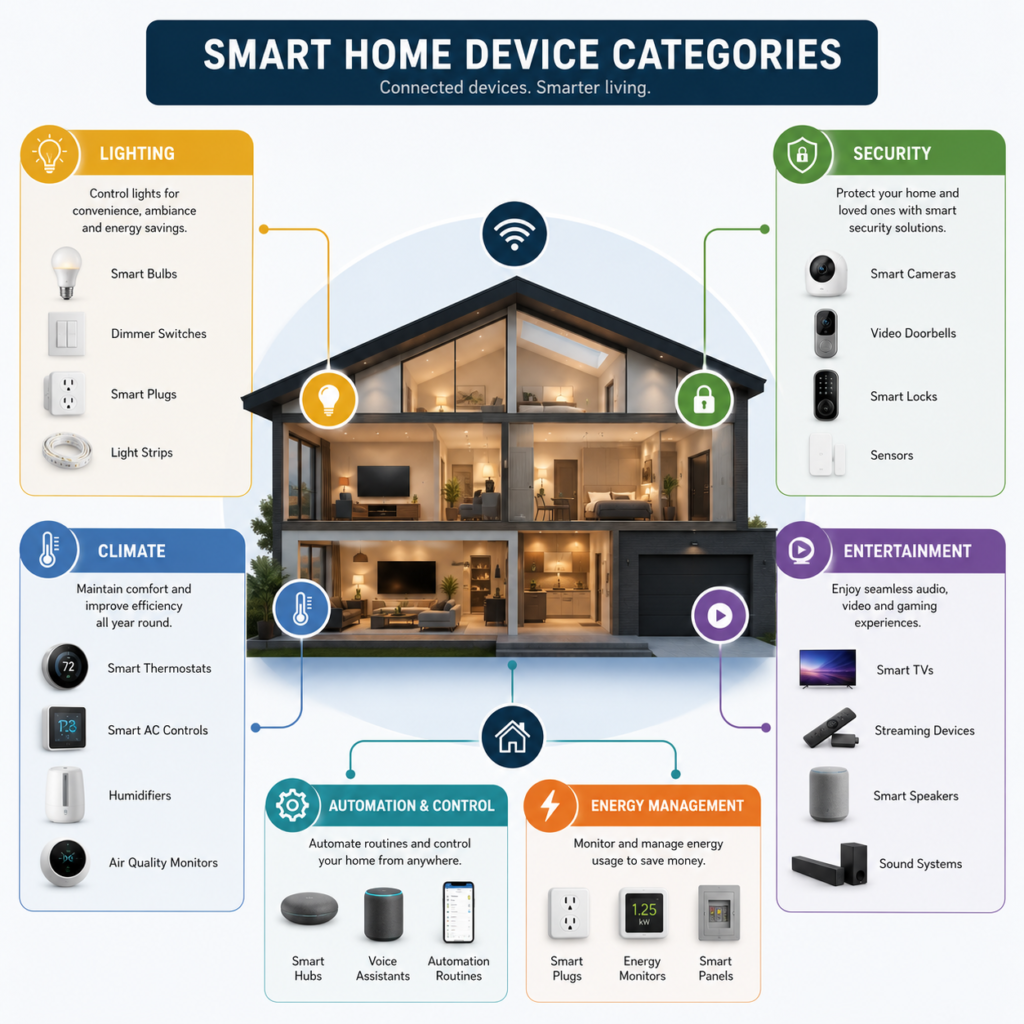
Infographic showing mart home device categories including lighting, security, climate and entertainment.
FAQ Section
What is decoradtech and how is it different from a regular smart home?
Decoradtech refers to the practice of combining interior design thinking with smart home technology, so devices are chosen for both function and how well they fit into a space, rather than being installed as an afterthought.
How much does it cost to start upgrading my home with smart devices?
Costs vary widely, but a reasonable starting budget for a few core devices — a smart thermostat, a couple of smart bulbs, and a smart plug — typically falls in the range of a few hundred dollars, with the option to expand gradually.
Do all smart home devices need to be from the same brand?
No, but they should be compatible with the same hub or voice assistant platform. Cross-compatible standards have made this easier in recent years, though checking compatibility before purchase is still essential.
Is it safe to connect so many devices to my home network?
It can be, as long as you use strong, unique passwords, keep firmware updated, and ideally separate smart devices onto their own network band or guest network to limit exposure if one device is compromised.
What’s the best room to start with when upgrading?
Most people see the most immediate benefit starting in the living room or entryway, since lighting and security upgrades tend to be noticed daily and provide quick, tangible improvements.
How long does it take to fully set up a smart home?
A basic setup can be running within a single afternoon, but a truly well-integrated system — with tested routines and reliable automations — often takes a few weeks of gradual additions and adjustments.
Can smart home devices actually lower my energy bill?
Yes. Smart thermostats and lighting, when properly programmed, have been shown to meaningfully reduce energy waste, particularly in households where rooms were previously heated, cooled, or lit unnecessarily.
What happens to my smart devices if the internet goes down?
Most devices retain basic local functionality, like a smart lock still locking and unlocking manually, but cloud-dependent features such as remote access or voice control typically pause until connectivity is restored.
Conclusion
Building a smarter home doesn’t have to mean drowning in gadgets or spending a weekend wrestling with five different apps. The whole point of decoradtech is to make your home work better for the way you actually live in it — quietly, reliably, and without demanding constant attention. Start small, pick devices that solve real problems in your space, and let the system grow room by room. A few months from now, you’ll likely find that the upgrades you barely think about anymore are the ones making the biggest difference.
Tags: decoradtech, smart home devices, home automation, home upgrade ideas, smart home setup, home technology, decoratoradvice, home renovation tech, energy efficient homes, connected home devices, home security tech, smart thermostats, home improvement 2026, DIY smart home