

There’s a reason the dinner table always ends up being the place where everyone gathers, even when the rest of the house has plenty of room to spread out. If you’ve ever hosted a holiday meal and watched half your guests balancing plates on their knees because the table ran out of edge space, you already understand the appeal of a large round dining table. It’s not just a piece of furniture — it’s the thing that decides whether your next dinner party feels cramped or comfortable.
Round tables have quietly become one of the most requested styles in home furnishing over the past few years, and it’s not a coincidence. Designers and homeowners alike are rediscovering something that older farmhouses and formal dining rooms figured out generations ago: a circle seats people more efficiently, encourages better conversation, and simply looks more inviting than a long rectangular slab of wood.
This guide walks through everything worth knowing before you buy — sizing, wood types, styles, durability, and a few practical tips that most furniture sites gloss over.
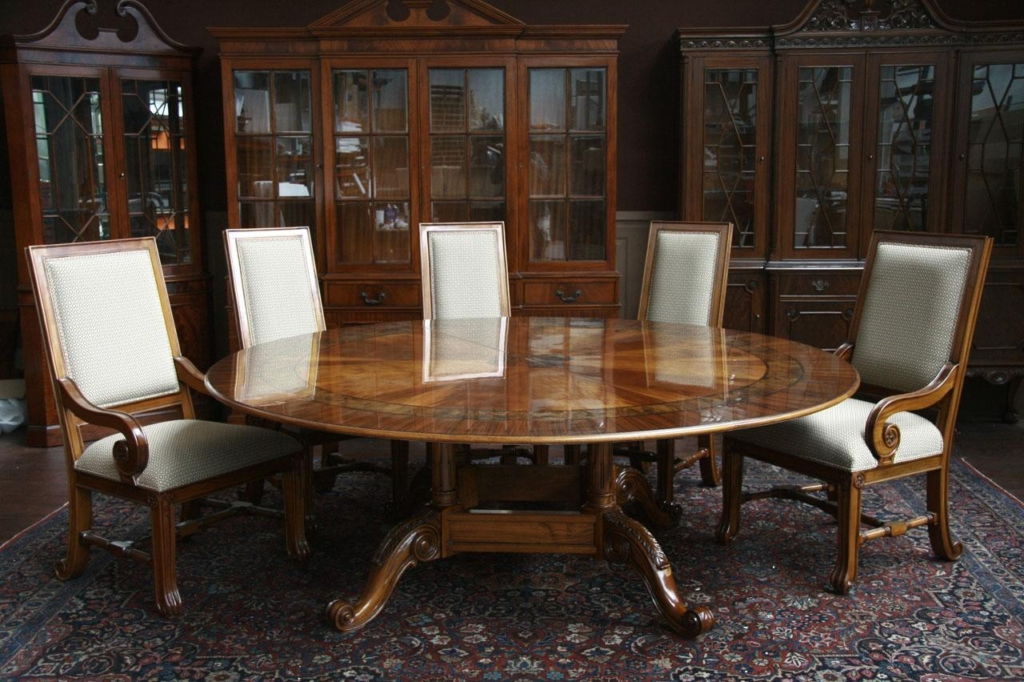
A large round dining table brings the whole family together without a single ‘head of the table.
Why Choose a Large Round Dining Table for Your Home
A large round dining room table solves a problem that most people don’t even realize they have until they’ve lived with one. Rectangular tables create “head” and “foot” positions, corner seats nobody wants, and awkward reaching for the salt shaker across a long stretch of wood. A large circle dining table removes all of that hierarchy. Everyone sits at an equal distance from the center, which naturally makes conversation flow better — there’s a reason round tables are the go-to choice for negotiations, family therapy rooms, and diplomatic summits.
There’s also a practical spatial argument. A big round dining table actually fits more people into less square footage than a rectangular one of a similar size, because you’re not losing usable space to sharp corners. If you’ve got a smaller or oddly shaped dining room, a round large dining table often makes the space feel more open, not less, since it lacks hard angles that visually “cut” a room.
The Psychology Behind Round Seating
Researchers studying group dynamics have long noted that circular seating arrangements reduce perceived social distance and encourage more balanced participation in conversation, compared to rectangular arrangements where people at the ends often dominate or get left out. That’s part of why so many boardrooms and mediation spaces use round tables — and it’s exactly the same effect you get at home with a round dining table large enough to seat your whole family.
Understanding Sizes: How Big Should Your Table Be?
This is where most buyers get stuck. “Large” means different things depending on who’s selling the table, so it helps to think in actual numbers.
As a general rule:
- 48–54 inches in diameter comfortably seats 4 people
- 60 inches seats 6 people
- 66–72 inches seats 6–8 people
- 84–96 inches (often with leaves) seats 8–10 people
If you’re shopping for large round tables for a family that regularly hosts, aim for at least 60 inches. Anything smaller and you’ll find elbows bumping during a full dinner.
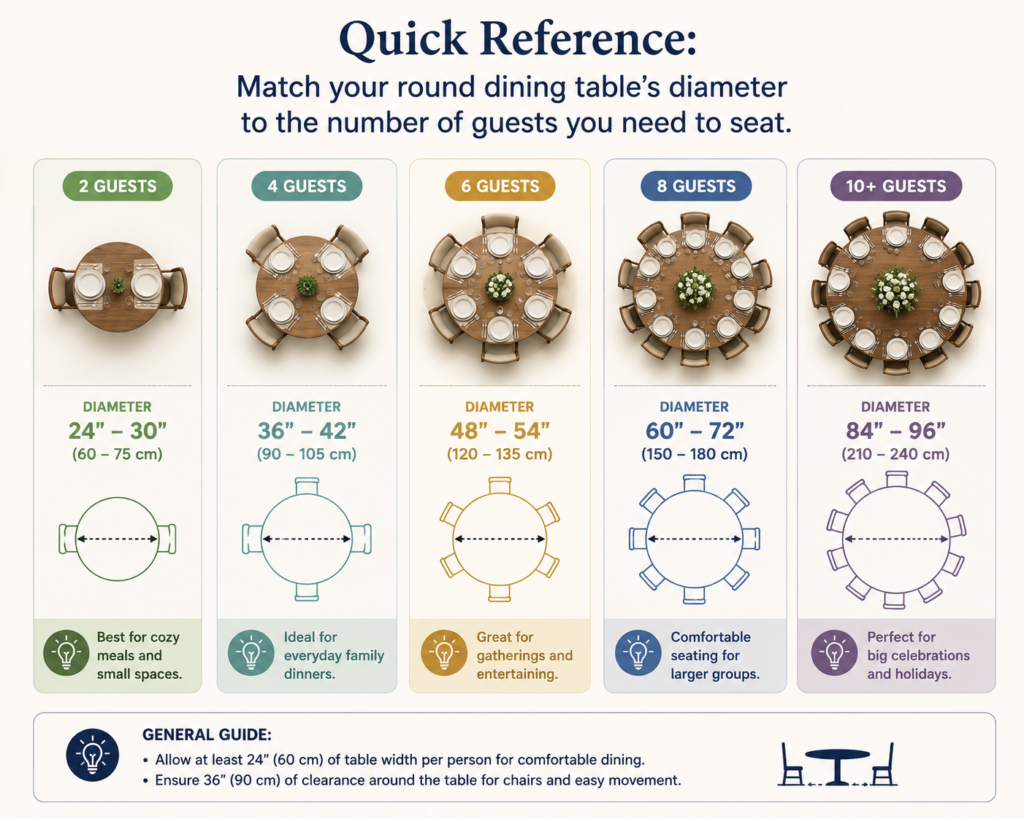
Quick reference: match your round dining table’s diameter to the number of guests you need to seat.
Round Wood Dining Table for 6: The Sweet Spot
For most households, a round wood dining table for 6 hits the ideal balance — big enough for a proper family dinner and guests, but not so large that it swallows a mid-sized dining room. A 60-inch table is the standard benchmark here, giving each person roughly 24 inches of table edge, which designers generally consider the minimum for comfortable elbow room.
Extra Large Round Dining Table Options
If you regularly host bigger gatherings, an extra large round dining table — typically 72 inches or more — is worth the investment. Some manufacturers build these with extension leaves that convert a large circle table into an oval when you need the extra length, giving you flexibility without permanently dedicating floor space to a table that’s oversized for everyday use.
Quick Size Reference
| Diameter | Seats | Best For |
| 48–54 in | 4 people | Small dining rooms, apartments |
| 60 in | 6 people | Most families, everyday use |
| 66–72 in | 6–8 people | Frequent entertaining |
| 84–96 in | 8–10 people | Large families, formal dining rooms |
Wood Types and Finishes That Actually Hold Up
Wood choice matters more than most buyers expect, especially because a dining table takes a beating: spills, hot pans, kids doing homework, the occasional dropped fork. A wood round dining table made from real hardwood will simply outlast a veneer or engineered-wood alternative by decades, not years.
Solid Wood Round Dining Table Benefits
A solid wood round dining table is built from actual timber rather than a particleboard core wrapped in a wood-look laminate. The advantages are practical, not just aesthetic:
- Durability — solid wood can be sanded and refinished multiple times over its life, so scratches and water rings aren’t permanent
- Structural strength — a round solid wood dining table distributes weight more evenly than composite materials
- Character — natural grain patterns mean no two tables look exactly alike
Common choices for a round dining tables wood build include oak, walnut, acacia, and mango wood, each with different grain patterns, price points, and hardness ratings. Oak and acacia rank among the harder, more dent-resistant options, which is worth considering if you have young kids or host frequently.
Dark Wood Round Table vs. Light Finishes
The finish you choose changes the whole feel of a room. A dark wood round table — think espresso, walnut, or ebonized oak — reads as more formal and pairs beautifully with warm metals like brass or bronze. It also tends to hide minor scuffs better than lighter finishes.
On the other hand, a lighter large round wooden table in natural oak or whitewashed finishes tends to open up smaller rooms and works especially well in Scandinavian, coastal, or farmhouse-style interiors. If you’re unsure which direction to go, bring home a wood sample or paint swatch and view it under your actual lighting before committing — showroom lighting can be deceptively flattering.
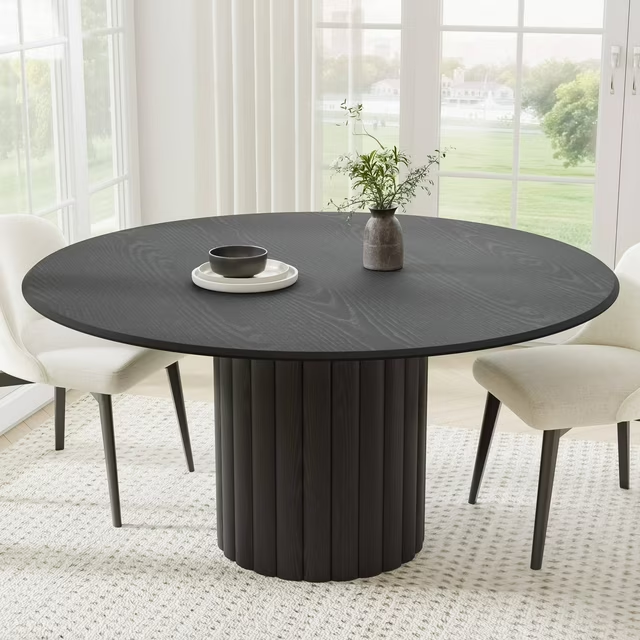
Dark wood finishes give a round dining table a formal, grounded feel — perfect for pairing with brass or bronze accents.
Styles to Match Your Home
Modern Round Dining Table Design
A modern round dining table typically favors clean lines, minimal ornamentation, and a pedestal or trestle base rather than four individual legs — partly for looks, and partly because a single central base gives everyone more legroom. Materials often blend wood tops with metal bases, or use a monochromatic palette in matte black, white oak, or warm walnut.
If your home leans contemporary, a modern large round dining table with a wide pedestal base tends to photograph and function better than a four-legged design, since it avoids the awkward “kicking a table leg” problem that plagues larger gatherings.
Round Formal Dining Table for Traditional Homes
Not every home wants minimalist. A round formal dining table, often crafted from dark round dining table finishes like mahogany or cherry, with turned legs and inlaid detailing, suits homes with more classic or traditional architecture. These pieces tend to be heavier and more ornamental, built to anchor a dedicated dining room rather than double as a casual eating space.
Circle Dining Room Table Shapes and Variations
Not all round tables are true circles. A circle dining room table can also come as a “racetrack” oval hybrid, or as a round dining wood table with drop leaves that fold down when not in use — a smart option for smaller households that occasionally need extra capacity. If flexibility matters to you, look specifically for models advertised with extension leaves, since not every round wood dining table is designed to expand.
Choosing a Sturdy Round Dining Table That Lasts
Sturdiness isn’t just about weight — it’s about construction. A sturdy round dining table should have these features:
- Thick tabletop — at least 1 inch of solid wood or high-quality veneer over engineered core
- Reinforced apron or skirt — the band of wood beneath the tabletop that connects the legs and prevents wobble
- Mortise-and-tenon or dowel joinery — stronger and more durable than glue-and-screw construction
- A wide, stable base — pedestal tables need a base diameter of roughly 60–70% of the tabletop diameter to avoid tipping
When shopping in person, don’t be shy about giving the table a gentle push test. A well-built large round wood dining table shouldn’t rock or creak. If you’re buying online, check customer reviews specifically for mentions of wobbling or joint failure after a few months of use — that’s usually the clearest red flag for a poorly constructed piece.
Popular Brands Worth Knowing: James and James Dining Tables
If you’ve spent any time browsing solid wood furniture online, you’ve likely come across james and james dining tables. James and James built a reputation around handcrafted, made-to-order solid wood furniture, offering buyers the ability to customize dimensions, wood species, and finish rather than settling for standard factory sizing.
For someone hunting for a james and james table specifically, the appeal is customization — you’re not limited to whatever diameter happens to be in stock. This matters a lot for large round dining tables, since off-the-shelf retailers often cap out around 60 inches, while custom builders can go considerably larger to fit oversized dining rooms or extended families.
That said, custom furniture generally comes with a longer lead time and higher price tag than mass-produced options, so it’s worth weighing how much the extra customization is really worth for your specific space.
Round vs. Rectangular: Why Big Round Tables Win for Many Homes
It’s worth addressing the elephant in the room: why choose round at all when rectangular tables are more common?
A big round dining table genuinely outperforms a rectangular one in a few specific situations:
- Square or near-square rooms — a circle fits the room’s proportions better than a long rectangle
- Open-concept layouts — round shapes create better traffic flow since there are no corners to navigate around
- Frequent entertaining — round seating naturally encourages conversation across the whole table rather than splitting into separate side conversations
The trade-off is that a big round dining room table generally needs more clearance around its full circumference to allow chairs to pull out, whereas a rectangular table only needs clearance on its long sides. Measure your room carefully — most designers recommend at least 36 inches of clearance between the table’s edge and the nearest wall or furniture piece.
Where to Place a Large Circular Dining Table
Placement affects both function and flow. For a large circular dining table, aim to center it within the dining area rather than pushing it toward one wall, since the whole point of a round shape is equal access from every angle. If your dining space doubles as a walkway to the kitchen, leave a wider gap on that side specifically, since it will see the most foot traffic.
Lighting matters too — a circular pendant or chandelier centered above a large round kitchen tables setup reinforces the symmetry of the room and avoids the visual clash of a rectangular fixture over a circular tabletop.
Frequently Asked Questions
What size is considered a large round dining table?
Generally, anything 60 inches in diameter or larger is considered a large round dining table. Tables in the 66–72 inch range comfortably seat 6–8 people, while an extra large round dining table at 84–96 inches can accommodate 8–10 guests, especially with extension leaves.
How many people can sit at a 72-inch round table?
A 72-inch round table typically seats 6 to 8 people comfortably, assuming roughly 24 inches of table edge per guest.
What wood is best for a round dining table?
Oak, walnut, acacia, and mango wood are among the most popular and durable choices. Oak and acacia tend to be harder and more resistant to dents, making them a solid choice for a solid wood round dining table in a busy household.
Is a round or rectangular dining table better for a small room?
A round table is often the better choice for a small or square room, since it lacks sharp corners that can make a space feel cramped, and it improves traffic flow around the perimeter.
How much clearance do I need around a large round dining table?
Most designers recommend at least 36 inches of clearance between the table’s edge and any wall or furniture, so chairs can be pulled out and people can walk around comfortably.
Are round tables sturdier than rectangular tables?
Sturdiness depends more on construction quality than shape, but a well-built sturdy round dining table with a wide pedestal base and solid joinery can be just as stable — sometimes more so, since weight is distributed evenly around a central support rather than four separate legs.
Can a large round dining table fit in a small dining room?
Yes, as long as you leave adequate clearance on all sides. A round large dining table often works better than a rectangular one in a compact square room, since it avoids blocking corners.
What’s the difference between a round and circle dining table?
There’s no real difference — “round” and “circle” are used interchangeably in furniture listings. A large circle table and a large round table describe the same basic shape.
Do round dining tables come with extension leaves?
Many do, particularly custom-built options. Adding a leaf typically converts the table into an oval shape, which is a practical way to get flexible seating without committing to a permanently oversized table.
Final Thoughts
Choosing a dining table is one of those decisions that quietly shapes daily life more than people expect — it’s where meals happen, where homework gets done, where holidays are hosted. A well-chosen large round dining table brings people together in a way that few other furniture pieces can, both literally and in terms of how it changes the feel of a conversation.
Whether you land on a rustic round wooden table, a sleek modern round dining table, or a custom-built piece from a maker like James and James, the fundamentals stay the same: measure your space honestly, prioritize solid construction over trend-driven looks, and choose a size that fits how you actually live — not just how many guests you might host once a year. Get those basics right, and the table you choose today is one you’ll likely still be gathered around a decade from now.