

There’s a particular kind of silence that happens when someone opens a beautifully designed room for the first time — and a very different kind of silence that happens when they read a poorly written description of that same room. One pulls you in. The other makes you scroll past. If you’ve ever wondered why some interior design content makes you want to book a consultation immediately, while other content—technically accurate, full of the right words—leaves you cold, the answer usually comes down to luxury interior design writing, and whether the person behind the keyboard actually understands the difference between describing a space and making someone feel it.
This matters more than most designers, agencies, and home brands realize. A gorgeous portfolio photo gets someone to stop scrolling. But it’s the writing around that photo — the captions, the blog posts, the project narratives — that gets them to trust you enough to inquire, to remember your name, and eventually to hire you. Good luxury interior design writing isn’t decoration on top of the real work. It is, in a very real sense, part of the real work.
This guide walks through what separates forgettable design copy from the kind that builds a client base, using examples and reasoning you can actually apply the next time you sit down to write about a finished room, a mood board, or a brand like LuxuryInteriors.org. None of it requires a journalism degree or years in the trade. It requires slowing down, noticing more than the average viewer would, and resisting the urge to reach for the same five adjectives every other home blog has already worn out.
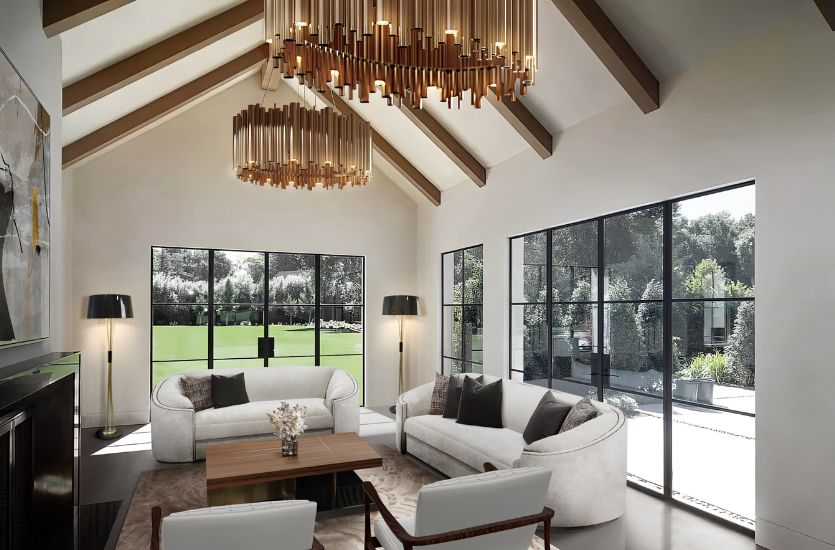
A room like this only sells itself if the words around it do their share of the work too — light, texture, and scale are easy to photograph and hard to describe well.
What Makes Luxury Interior Design Writing Different From Regular Home Content
There’s a meaningful gap between writing about a $40 throw pillow from a big-box store and writing about a hand-loomed Belgian linen sofa that took fourteen weeks to arrive. Both are technically “home content.” Only one requires luxury interior design writing, and the distinction isn’t snobbery — it’s about matching the tone of the words to the expectations of the reader.
Someone researching budget-friendly decor wants speed, clarity, and value. Someone researching a six-figure renovation wants something closer to reassurance. They’re not just buying a sofa or hiring a designer — they’re trying to determine whether the person describing the work actually understands craftsmanship, scale, and taste at the level they’re paying for. If the copy reads like generic listicle filler, that trust collapses before the first paragraph ends.
The Reader Is Evaluating Expertise, Not Just Aesthetics
High-end clients are unusually good at detecting surface-level knowledge. They’ve sat through enough designer consultations to know the difference between someone who says “we’ll add some texture” and someone who says why a boucle-upholstered bench works better against a Venetian plaster wall than a velvet one would. Writing for this audience means doing the homework — understanding finishes, fabrication timelines, and the vocabulary that signals real fluency in the field.
This is also why this kind of copywriting tends to slow down rather than speed up. Mass-market content is built for skimming. Luxury content is built for lingering — for readers who want to be walked through a decision, not just handed a conclusion.
The Core Principles Behind Writing That Actually Sells the Room
Every strong piece of interior design copy, whether it’s a single Instagram caption or a 2,000-word project feature, tends to share a handful of traits. None of them are complicated. Most of them are simply skipped because they take more time than writing a generic description.
Lead With Sensory Detail, Not Adjectives
“Elegant,” “stunning,” and “luxurious” are not bad words, but they’ve been used so often that they’ve stopped doing any work. They tell a reader what to feel without giving them a reason to feel it. Sensory detail does the opposite — it puts the reader in the room.
Instead of “an elegant living room,” consider something like: morning light catching the brushed brass edge of a coffee table, or the way a wool bouclé sectional seems to absorb sound the moment you walk in. These are the kinds of details that make luxury interior design writing feel earned rather than asserted.
A few ways to build sensory detail into a description:
- Reference how a material feels underfoot or under a hand (cool marble, nubby linen, warm reclaimed oak)
- Describe how light moves through a room across the day, not just how the room looks in one photo
- Mention scale in human terms — a nine-foot island that seats six, a ceiling height that makes a six-foot-four guest still feel small
- Note sound and acoustics, which almost no one writes about but every high-end client notices
Use Precise Material and Trade Vocabulary
Generic copy says “high-quality materials.” Precise copy says Calacatta gold marble, hand-knotted Tibetan wool, or quarter-sawn white oak. The specificity isn’t there to show off — it’s there because precise nouns are what separate a writer who understands the trade from one who’s guessing.
This is one of the places where luxury interior design writing quietly does SEO work without ever feeling like it’s trying to. Long-tail material terms, finish names, and design movement references (Japandi, French country, mid-century revival, organic modern) are exactly what people type into search bars when they’re far enough into their research to know what they want. Writing naturally in this vocabulary, rather than avoiding it for fear of sounding inaccessible, tends to serve both the reader and the search engine at the same time.
Build a Narrative Arc, Even for a Single Room
The strongest project write-ups treat a room the way a good essay treats an argument — there’s a beginning (the problem or blank slate), a middle (the decisions and trade-offs), and an end (the resolved space). This is different from a feature list that says “this room includes X, Y, and Z.”
A short narrative structure might look like this:
- The starting point — what the space was before, or what constraint shaped the brief (a narrow lot, an awkward ceiling height, a client who hated open shelving)
- The pivotal decision — the one choice that changed the direction of the whole room, explained honestly, including what was considered and rejected
- The resolution — how the finished space answers the original problem, ideally tied back to how someone actually lives in it
This structure works whether you’re writing for a design firm’s portfolio, a real estate listing, or a brand like LuxuryInteriors.org that’s building out an editorial library. It gives even a single photograph somewhere to live narratively, instead of floating in isolation.
Readers researching design inspiration respond strongly to before-and-after framing because it mirrors their own situation — most people start a renovation from a place of dissatisfaction, not a blank canvas.
Common Mistakes That Undercut Otherwise Beautiful Projects
Even strong design work can be undersold by weak writing. A few patterns show up again and again across the industry, and they’re worth naming directly.
Overusing Superlatives Until They Mean Nothing
When every room is “breathtaking” and every kitchen is “the heart of the home,” readers stop trusting the description entirely. Superlatives work best when they’re rationed — saved for the one detail in the project that actually earns the word, rather than sprinkled across every paragraph as a substitute for specificity.
Ignoring the Practical Questions Readers Actually Have
Luxury doesn’t mean impractical, and readers researching high-end design still want to know things like maintenance requirements, durability, lead times, and budget ranges, even in broad terms. Content that floats entirely in aspirational language without acknowledging these questions tends to feel disconnected from how people actually live and make decisions. The best luxury interior design writing holds both — the dream and the logistics — without letting one crowd out the other.
Writing for the Designer’s Ego Instead of the Reader’s Decision
It’s tempting to write project descriptions as a showcase of design philosophy. Sometimes that’s appropriate. But most readers arrive at a piece of content trying to solve a problem of their own — how do I make my living room feel bigger, what do I do with an awkward staircase landing, how do I choose between warm and cool whites. Content that answers a real question, even while showcasing beautiful work, tends to perform better and build more trust than content that only talks about the brand.
Structuring an Article So It Reads Naturally and Ranks Well
There’s a reasonable concern that writing for readers and writing for search engines pull in opposite directions. In practice, they overlap more than people expect, because both reward clarity, structure, and genuine usefulness.
Headings Should Reflect How a Reader Actually Thinks Through the Topic
Strong headings aren’t keyword containers — they’re signposts that mirror the questions a reader is already asking themselves. “How to Choose a Sofa Fabric for High-Traffic Rooms” is more useful, and ultimately more discoverable, than a vague heading like “Sofa Tips.” The same logic applies across an entire article on this topic: organize around real questions, and the structure tends to take care of itself.
Keep Paragraphs Short Enough to Breathe
Long, unbroken paragraphs are exhausting on a screen, especially for design content where readers are often scanning between text and photography. Two to four sentences per paragraph keeps the pacing comfortable without sacrificing depth. This also makes space for visuals to sit naturally within the flow of the piece, rather than being crammed in as an afterthought.
Definitions Earn Their Place When They’re Genuinely Useful
Not every reader knows what “millwork” or “reveal” or “scenic wallpaper” means, and a quick, unpretentious definition built into the flow of a paragraph (rather than a clunky glossary box) keeps the content accessible to newer readers without insulting more experienced ones.
For example: Millwork refers to custom wood detailing — trim, paneling, built-ins — that’s fabricated specifically for a space rather than bought off the shelf. A single clear sentence like that does more for both readability and search relevance than an entire separate glossary section would.
Writing for a Brand Voice: What This Looks Like in Practice
Sites built around a strong point of view — including a brand like LuxuryInteriors.org — tend to succeed when their writing has a consistent personality across every piece, not just a consistent topic. That voice usually has a few ingredients: a point of view on taste (not neutral, but not snobbish either), a willingness to explain the “why” behind design choices, and language that respects the reader’s intelligence.
A few practical habits support this kind of consistency:
- Decide early whether the brand voice is warm and conversational or more editorial and authoritative, and apply that choice consistently
- Avoid alternating between overly casual slang and overly formal trade jargon within the same piece
- Let opinions show — readers trust a writer who will say a trend has staying power or a finish tends to look dated faster than expected, rather than one who stays neutral on everything
- Revisit older content periodically, since design trends and material availability shift, and outdated references quietly erode trust
This consistency is, in many ways, the long-term payoff of investing in luxury interior design writing as a discipline rather than treating it as an afterthought tacked onto finished photography.
Editing Your Draft Like a Designer Reviews a Floor Plan
A first draft of a project description is a lot like a first pass at a floor plan — useful as a starting point, but rarely the version that should go out the door. The editing stage is where most of the real craft happens, and it’s also the stage most people rush through because the hard part, getting words on the page, already feels finished.
Read It Aloud Before You Publish It
This sounds almost too simple to mention, but reading a draft aloud catches problems that silent reading misses every time. Awkward rhythm, repeated sentence structures, and phrases that sound fine in your head but clunky out loud all surface the moment you say them. If a sentence makes you stumble while reading it, a reader will stumble too, even if they’re reading silently.
Cut the First Paragraph More Often Than You’d Expect
A common pattern in early drafts is throat-clearing — a paragraph or two of warm-up before the writing actually gets going. Often the second or third paragraph is where the piece truly begins, and the opening can be deleted entirely without losing anything. This is worth checking on every single draft, because the habit of warming up before writing is hard to break, even for experienced writers.
Check for Repetition Across a Series of Project Posts
If you’re maintaining an ongoing blog or portfolio, it’s worth periodically reading several pieces back to back. Patterns that aren’t obvious in isolation — always opening with weather, always describing the client the same way, always reaching for “transformed” as the verb of choice — become obvious when you see five posts in a row. A quick audit every quarter or so keeps the writing feeling fresh rather than formulaic.
Ask Whether a Non-Expert Would Still Follow It
The final check worth running on any piece is simple: would someone with no design background still understand what’s being described, even if they don’t know every term? Precision and accessibility aren’t opposites. The best writing in this space manages both — specific enough to satisfy someone who works in the trade, clear enough that someone shopping for their first home renovation doesn’t feel lost.
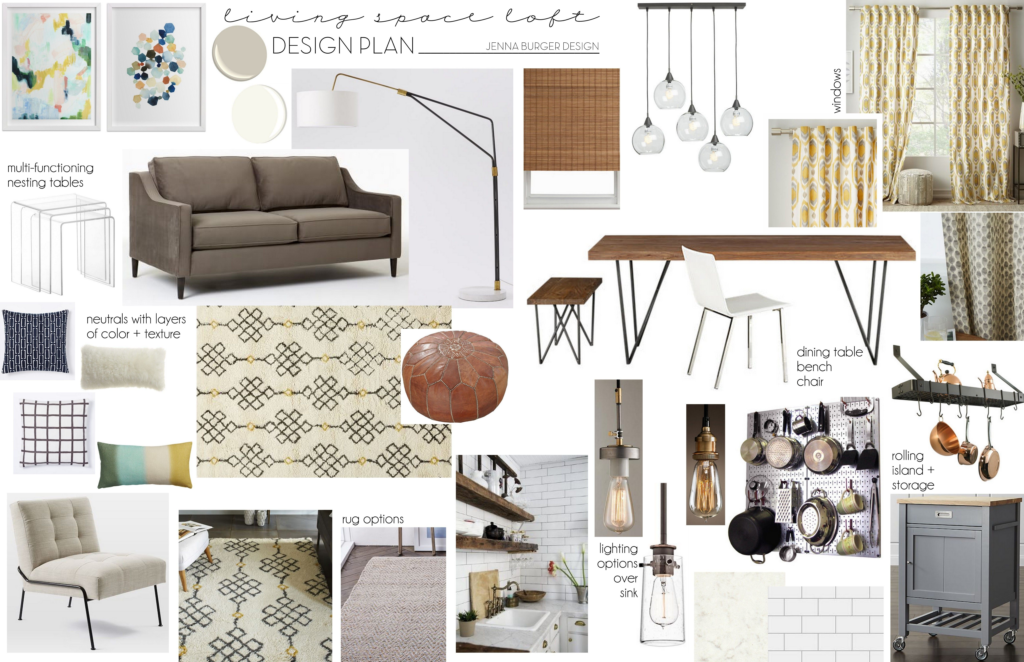
Behind every polished room description is usually a mood board like this one — the raw material the writer translates into language.
How Visuals and Words Work Together in High-End Design Content
Photography carries enormous weight in interior design content, but text and image aren’t competing for attention — they’re doing different jobs. A photo shows the finished result. Writing explains the reasoning, the materials, and the experience of being in the space, which a photo alone can’t fully capture.
The strongest design content treats captions and surrounding text as an extension of the room itself, not a label slapped onto it. A caption that says “primary bedroom suite” wastes an opportunity. A caption that notes why the headboard was upholstered in a textured bouclé to soften the room’s otherwise sharp architectural lines gives the reader something to actually learn.
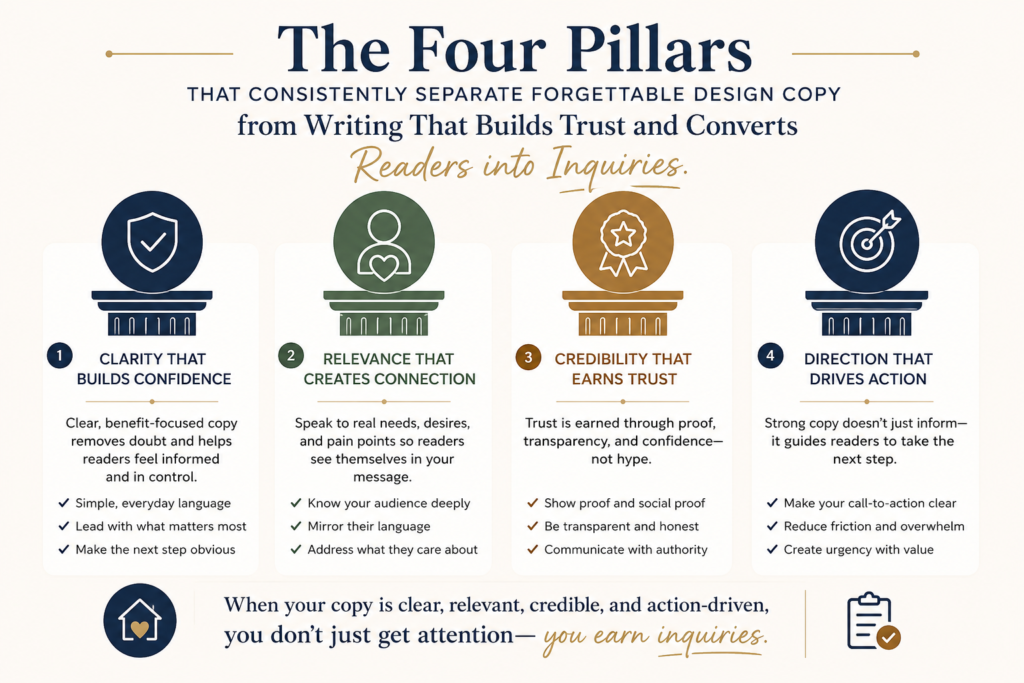
The four pillars that consistently separate forgettable design copy from writing that builds trust and converts readers into inquiries.
Frequently Asked Questions
What exactly is luxury interior design writing?
It’s a style of content writing focused on high-end residential and commercial interiors, built around precise material vocabulary, sensory detail, and narrative structure rather than generic adjectives. The goal is to help a reader understand and feel a space, not just see a list of its features.
Why does this style of content matter for SEO?
Detailed, specific writing naturally includes the long-tail terms — finish names, design styles, material types — that people actually search for when researching a renovation or design project. It also keeps readers on a page longer, which signals relevance and usefulness to search engines.
How long should a luxury interior design project description be?
There’s no fixed number, but most strong project write-ups fall somewhere between 300 and 800 words — long enough to cover the starting problem, the key decisions, and the resolution, but tight enough to respect a reader’s time.
Do I need design experience to write well about interiors?
It helps enormously, but it’s not strictly required. What matters more is curiosity — being willing to ask a designer why they chose a particular finish or layout, and then translating that reasoning into language a non-expert can follow.
How do I avoid sounding repetitive across many project descriptions?
Vary the entry point of each piece. Some pieces can open with the client’s original problem, others with a striking material choice, others with how the space is actually used day to day. Repetition usually comes from always starting in the same place, not from limited vocabulary.
Should luxury content avoid mentioning price or budget?
Not necessarily. Vague budget ranges, described thoughtfully, often build more trust than complete silence on the topic, since readers researching high-end work are usually trying to calibrate their own expectations.
What’s the biggest mistake brands make with design content?
Treating writing as filler around photography rather than as a tool that builds trust and search visibility in its own right. The brands that invest real time in their writing tend to see it compound over months and years, not just in a single post.
How does a site like LuxuryInteriors.org maintain quality across many writers?
Usually through a documented style guide covering tone, vocabulary preferences, and structural expectations, paired with an editorial review step that checks for both accuracy and voice consistency before anything publishes.
Conclusion
Good design speaks for itself in person, but online, it needs help. Photography alone can’t explain why a decision was made, what it felt like to solve a difficult layout problem, or why a particular material was worth the wait. That’s the job of the writing around it. Luxury interior design writing isn’t about reaching for fancier words — it’s about being specific enough, honest enough, and observant enough that a reader who’s never set foot in the room can still picture exactly what it feels like to stand in it. Get that right, consistently, and the words start doing as much work as the photographs ever did.